
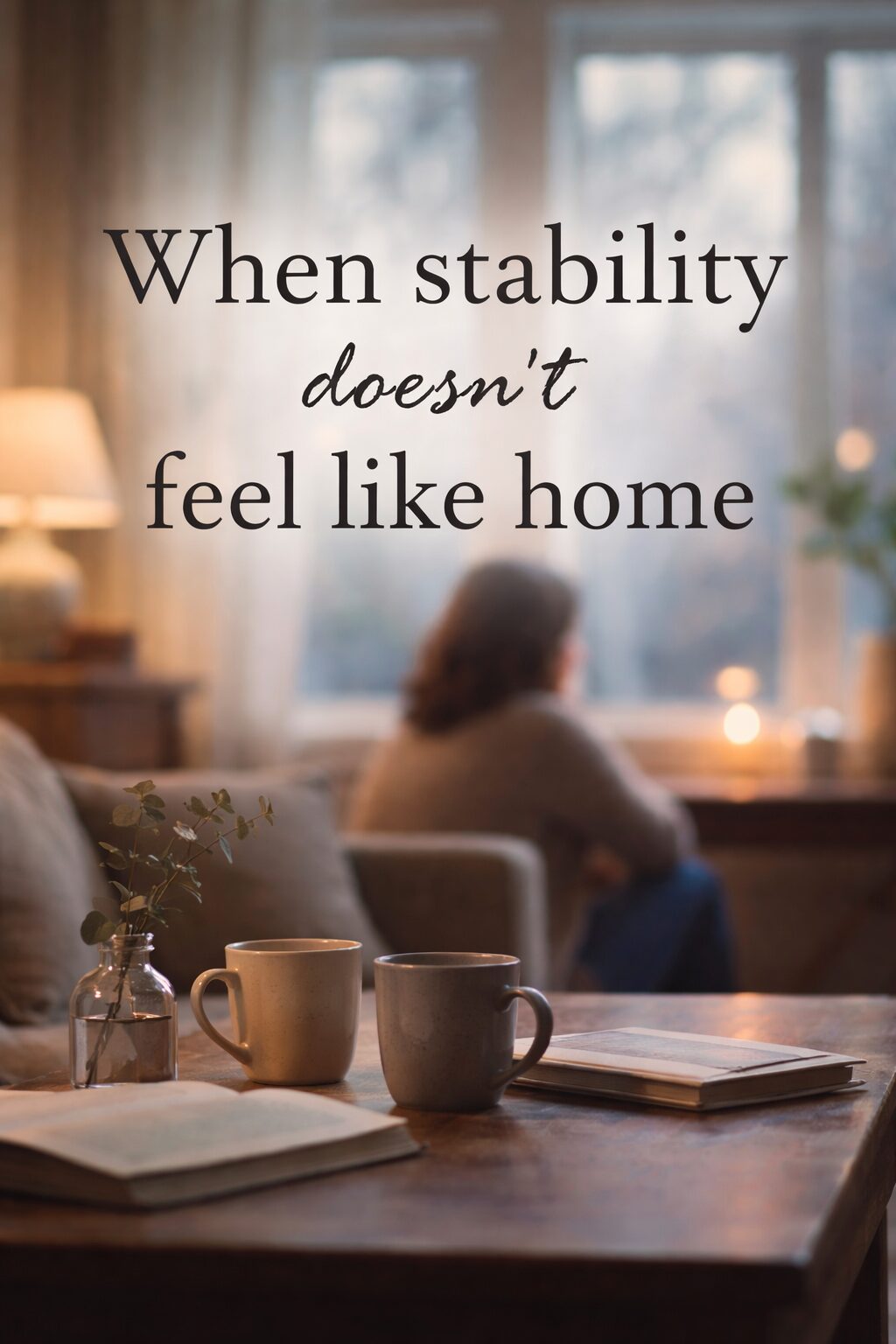
This essay is part of a longer inquiry into what it means to feel at home—
in our bodies, our relationships, and our lives—when home was never something we learned to expect.
You build the life you once wanted.
The partner. The children. The routines. The shared calendar on the fridge. The house that finally feels settled.
There are no major crises. No dramatic betrayals. No obvious lack.
And yet, some evenings — often in the quiet after the children are asleep — something unsettled moves inside you.
Not unhappiness exactly.
But not ease either.
You sit next to the person you chose. The room is calm. The dishes are done. A show plays in the background. And instead of relief, you feel a faint distance. As if something in you is still scanning, still waiting.
You wonder: Why doesn’t this feel like home in the way I thought it would?
Stability Is Quieter Than We Imagined
We are often told that once we choose well — choose wisely — the restlessness will soften.
That finding the right partner, building something steady, will settle the nervous system.
But stability is quiet.
And quiet can be unfamiliar.
For years, many of us lived in motion — pursuing, proving, adapting, striving. There was always something to solve, earn, anticipate. Even desire itself can carry a certain electricity.
Then one day, the pursuit slows.
And what remains is stillness.
Stillness does not create new feelings. It makes old ones easier to hear.
When Nothing Is Wrong, What Surfaces?
Long-term partnership is one of the safest relational containers most adults will ever experience. And safety does something surprising: it allows unfinished feelings to rise.
Attachment research suggests that our early relational patterns often reappear most clearly in close, enduring bonds (Hazan & Shaver, 1987). Not because something is broken — but because the bond is strong enough to hold what was previously managed.
In the rush of early love or early adulthood, certain parts of us stayed busy: pleasing, performing, achieving, adapting.
In stability, those parts have less to do.
And when protectors lose their job, they don’t retire gracefully. They get restless.
You might notice it as:
- Irritation when everything is calm
- Picking small arguments that don’t quite matter
- Fantasizing about a different life while folding laundry
- Starting projects just to feel movement
Nothing is catastrophically wrong.
But something in you feels under-stimulated.
Or exposed.
Safety Is Not the Same as Aliveness
For some nervous systems, intensity became associated with connection early on.
Unpredictability meant attention. Distance meant pursuit. Emotional activation meant you were needed.
So when a relationship becomes steady, kind, and predictable, the body may misread that steadiness as dullness.
Not because your partner is lacking.
But because your system learned that love feels like motion.
Peace can feel flat at first.
A calm evening can feel strangely empty.
You look around at a life that is objectively good — and feel a quiet ache you cannot explain.
The shame of that feeling can be heavier than the feeling itself.
The Loneliness No One Talks About
There is a particular kind of loneliness that appears inside stability.
It is not the loneliness of being unseen or mistreated.
It is the loneliness of realizing that no external structure can complete you.
You can be deeply loved and still feel alone in your own interior.
You can sit beside someone who knows your history and still feel a distance that has nothing to do with them.
Sometimes the ache is not about the relationship at all.
It is about the parts of you that never learned how to feel at home in yourself.
Stability does not create that gap.
It removes distractions from it.
Emotional Homelessness
Some of us did not grow up with a steady sense of internal ground.
We learned to adjust to others, to anticipate moods, to be useful, impressive, calm, agreeable.
We built belonging through effort.
When you enter a stable partnership, that strategy may no longer be required.
And without the constant work of earning connection, a question surfaces quietly:
If I am not striving, who am I?
If nothing is being demanded of me, what moves me?
That question can feel like emptiness.
But it is often the beginning of something more honest.
Staying Is Not Passive
There is a fantasy that if you find the right home, you will stop searching.
But for many adults, the deeper work begins after the search ends.
Staying — in a relationship that is fundamentally safe — removes easy exits.
You cannot blame chaos.
You cannot chase novelty.
You cannot distract yourself with constant change.
You sit.
And you meet what surfaces.
This does not mean every relationship should be preserved at all costs. Some dynamics are truly harmful.
But in a stable, caring bond, restlessness is not always a sign that you chose wrong.
Sometimes it is a sign that you are finally still enough to feel what has been waiting underneath.
A Different Kind of Home
Home may not be the disappearance of longing.
It may be the place where longing becomes visible.
Where the nervous system slowly learns that calm is not neglect.
Where aliveness expands beyond intensity.
Where you begin to build internal ground instead of searching for it in movement.
You look around one evening — at the quiet kitchen, at the familiar face across from you — and realize the work is not about leaving.
It is about learning how to stay inside yourself while you stay with someone else.
And that kind of home is built slowly.
Reference
Hazan, C., & Shaver, P. (1987). Romantic love conceptualized as an attachment process. Journal of Personality and Social Psychology, 52(3), 511–524.
Explore Further:
On Feeling at Home: A Series on Belonging, Movement, and the Lives We Build
Belonging Everywhere and Nowhere
The Paths We Walk and Those We Leave Unwalked: Choice, Regret, and Self-Trust (+ Free Journal)
What We Borrow From Films: Longing and Meaning When Life Leaves Little Room (+Free Resource)
Dopamine-Seeking Habits and CEN: Risk and Thrill-Seeking (Part 1 of 6)
How Restorative Yoga Rewires Your Body and Mind — Even If You Struggle to Relax
Leave a Reply