
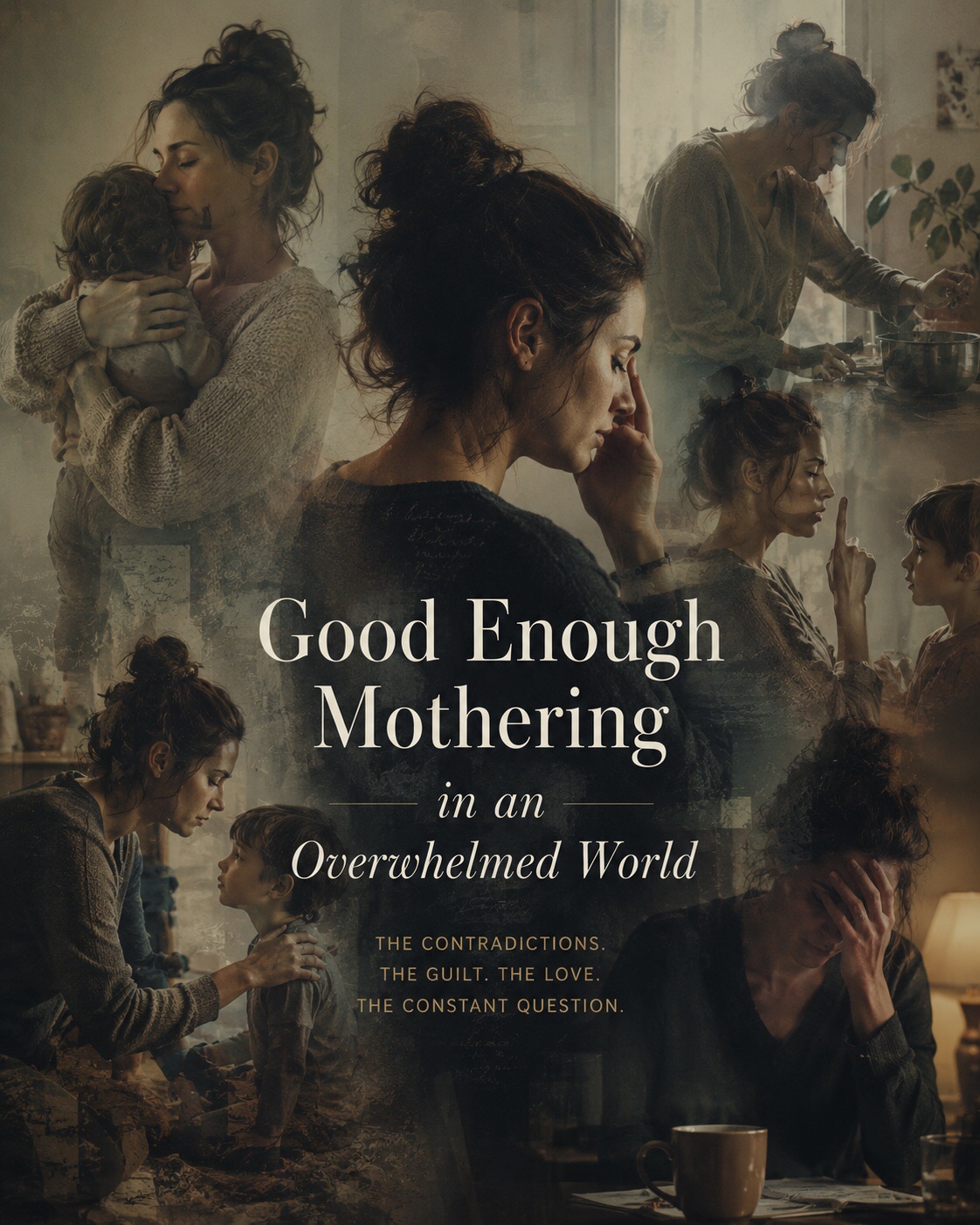
The house is finally quiet.
Not peaceful, just quiet. The kind that arrives after the dishes are stacked crooked in the rack, the lights are dimmed one by one, and a mother realises she has been moving for so many hours that stopping feels disorienting.
Sometimes she stands in the kitchen without meaning to, one hand against the counter, body still running slightly ahead of her.
When the day replays, what returns first are rarely the successes.
The sharpness in her voice after being touched one too many times.
The hesitation before responding to tears.
The look on her child’s face when she said no and meant it.
The strange guilt of wanting silence after hours of noise.
By evening, there is no momentum left to hide inside. No small emergencies to outrun herself through. Just the body replaying moments and asking, quietly but relentlessly:
Was I good enough today?
Not as an abstract question. As a physical one.
A tightening in the chest.
A scanning for damage.
A need to know whether love held, whether safety held, whether she held.
This is one of the hardest parts of motherhood to describe honestly. Not only the difficult moments themselves, but the aftermath of them. The private reckoning once the house goes still.
Because sometimes nothing catastrophic happened.
And yet the nervous system behaves as though something important was at stake all day long.
The Shifting Standard
Part of what makes this so exhausting is that “good enough” never stays in one place.
One day a mother worries she was too harsh. The next, she fears she was too permissive.
One week she feels emotionally absent, distracted by logistics, noise, and survival. The next, she becomes so absorbed in everyone else’s feelings that she cannot hear her own thoughts clearly anymore.
The standard keeps moving.
Some days good motherhood seems to mean patience.
Other days it means boundaries.
Sometimes presence.
Sometimes efficiency.
Sometimes repair.
Sometimes simply getting everyone fed and into bed without another eruption.
And because the target moves, many mothers live with the quiet feeling of constantly missing it by inches.
Children change by the hour. Context changes. Exhaustion changes people further still.
What feels loving in one moment can feel abandoning in another.
What feels regulating one day can replay at midnight as control.
What felt necessary at noon can suddenly seem cruel in the dark.
A mother can spend an entire afternoon trying to stay calm with an overstimulated child, only to lie awake later wondering whether the calmness felt reassuring or emotionally far away.
Or hold a boundary she knows was necessary, then feel physically sick afterward because the child cried while she maintained it.
The question slowly shifts.
Not:
“What is the correct way to mother?”
But:
“How do I know when I am creating safety, and when I am only trying to escape fear?”
The Hidden Question Beneath the Question
Much maternal guilt is not really about getting things “wrong.”
It comes from sensing, constantly, that something precious could be harmed.
Underneath many parenting decisions lives another question entirely:
Did everyone stay emotionally safe?
For some mothers, safety looks like order. Shoes on. Voices lowered. Bedtime held even when everyone is exhausted.
For others, safety looks like emotional closeness. Sitting on the bathroom floor beside a sobbing child while dinner goes cold in the next room.
For others, it looks like anticipation. Snacks packed, transitions prepared for, extra clothes brought everywhere because being unprepared feels unbearable.
For others, it looks like staying endlessly calm, because anger once felt frightening and unpredictable in their own childhood homes.
The forms change. The longing underneath them often does not. Underneath every shifting standard of “good enough” is a frightened attempt to create safety. Not only for the child. For the mother herself, too.
Some mothers cannot tolerate conflict because conflict once meant humiliation, withdrawal, or fear.
Some rush to soothe immediately because they remember too clearly what it felt like to cry without anyone coming.
Some over-explain every boundary because obedience without emotional safety once wounded them deeply.
Some become intensely controlling around mess or noise because chaos once swallowed the entire household whole.
And exhaustion changes these responses further.
Hyper-attunement can become self-erasure.
Appeasement can disguise panic.
Firmness can harden into emotional distance.
Withdrawal can appear in the middle of play, a mother nodding automatically while her nervous system quietly exceeds capacity.
These responses are not random.
Many were learned long before motherhood began.
Parenting simply has a way of bringing them to the surface.
Exhaustion Narrows Us
What makes all of this heavier is how little space most mothers have to recover.
There is information everywhere now. Advice everywhere. Opinions everywhere. But actual support (the kind that regulates a nervous system in real time) is often painfully absent.
What used to be shared across many nervous systems now runs through one.
The soothing.
The anticipating.
The remembering.
The emotional regulation.
The absorbing of everyone else’s overwhelm while suppressing your own.
And exhaustion changes people. Not only emotionally, but neurologically. It reduces flexibility.
A rested mother can move between responses more fluidly. Firm when needed, playful a moment later. Boundaried without becoming cold. Emotionally present without disappearing completely into another person’s distress.
Exhaustion narrows that range.
A mother may hear herself becoming sharper than she intended simply because there is no energy left for negotiation.
Or give in immediately because conflict feels physically unbearable.
Or over-explain every decision in an attempt to prevent tears before they begin.
Sometimes it looks like hiding in the bathroom for one extra minute before re-entering the noise.
Sometimes it looks like reheating the same cup of coffee three times and still never drinking it warm.
Sometimes it looks like scrolling numbly beside a child asking for attention, not out of indifference, but because the nervous system has quietly moved beyond capacity.
Most of these moments are judged morally.
Very few are understood physiologically.
Contradiction Inside One Moment
Sometimes all of these responses can exist inside a single interaction.
A child melts down in the supermarket after being told no.
At first the mother stays firm. The answer is still no. Her voice is steady, but her body is already tightening. People are looking.
Then comes problem-solving. Maybe a snack will help. Maybe offering choices will help. Maybe leaving the cart and moving faster will help.
The crying escalates.
Now another layer appears: empathy. The child is overwhelmed. Hungry, tired, overstimulated. The mother kneels down, softens her voice, tries to reconnect through the chaos.
But underneath the empathy, another feeling flickers too: Please stop. I cannot absorb any more noise.
Then guilt arrives immediately after the resentment. What kind of mother feels that while her child is crying?
By the time they leave the store, she may feel she has been five different mothers in ten minutes.
Can this be contained?
Can this be soothed?
Can this be solved?
Can this end quickly?
Can everyone get through this intact?
Motherhood often asks people to stay emotionally regulated inside conditions that would overwhelm many adults even with support. And because these shifts happen internally and quickly, mothers frequently judge themselves for inconsistency instead of recognising the sheer amount of adaptation taking place in real time.
Especially when exhausted.
Especially when alone.
The Inheritance Layer
Many mothers discover, often painfully, that parenting does not only reveal who they are.
It reveals what shaped them. Not in tidy therapeutic insights, but in flashes.
The panic that rises when a child ignores them repeatedly.
The urgency in the body when crying lasts too long.
The way certain tones of voice can suddenly make an adult feel small, helpless, enraged, or invisible again.
Parenting exposes old rules the body learned long ago. Some learned that love meant staying useful, calm, undemanding. Some learned that mistakes brought humiliation. Some learned that another person’s emotions had to be managed quickly before they became dangerous. Some learned that needs arrived as burdens inside already overwhelmed homes.
And then a child enters the picture with ordinary childhood behaviours:
crying,
clinging,
interrupting,
refusing,
wanting the same book five times in a row.
Because dependency naturally presses against whatever remained unresolved.
A mother may believe she is reacting only to the present moment, only to realise later that several different time periods were alive inside her at once.
The toddler refusing shoes.
The exhausted adult trying to cope.
The younger self who once learned what happened when tension entered a room.
All present together.
And still, most mothers continue trying.
Still repair. Still return. Still wake up the next morning and do it again.
That matters more than many of them realise.
When the Day Is Over
By night, the house grows quiet again.
Toys remain half-visible in dim light. Laundry waits somewhere nearby. A cup sits forgotten on the counter. The nervous system still humming slightly after a full day of holding, responding, anticipating.
And often the question returns:
Was I good enough today?
For many mothers, the instinct is to begin gathering evidence.
The moment patience failed.
The moment irritation showed.
The unfinished task.
The missed cue.
The repair that happened later than it should have.
But perhaps many maternal contradictions begin to make more sense once they are understood not as proof of failure, but as attempts at protection.
Protection of the child.
Protection of connection.
Protection of order.
Protection of a nervous system carrying more than it was ever meant to carry alone.
Fear can still narrow love.
Exhaustion can still wound.
Old survival strategies can still spill outward onto the people closest to us.
But shame rarely creates the conditions for real change.
Understanding does something else.
It creates a little more room.
A little more honesty.
A little more capacity to notice what is happening before being completely overtaken by it.
The dishes still wait in the sink. The toys are still scattered in the next room. Nothing is fully resolved.
Tomorrow the question may return.
But perhaps this, too, is part of motherhood: love continuing imperfectly through exhaustion, fear, noise, and return.
Explore further:
Growing Through Motherhood: A Guided Journal for Healing and Self-Discovery
The Many Faces of Grief in Motherhood: Healing from Loss and CEN (+Journaling Workbook)
The Need You Might Be Missing: When Hunger Feels Like Emotional Overwhelm
Leave a Reply