
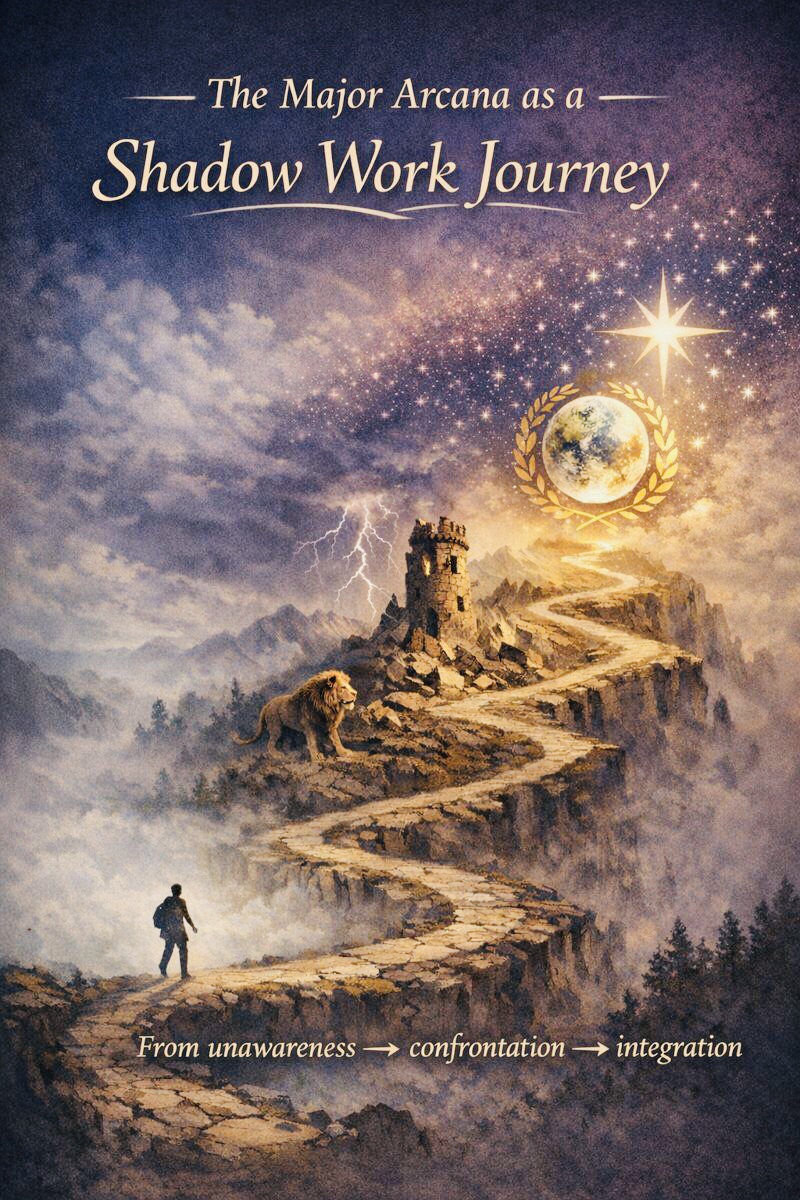
Have you ever pulled a tarot card that made your stomach tighten, even though you weren’t sure why? Or found the same card appearing again and again, as if the deck were trying to tell you something you weren’t ready to hear? These are subtle invitations from your unconscious—the parts of yourself that hide in plain sight, the pieces you might resist, avoid, or simply don’t notice.
Shadow work is the practice of meeting these hidden parts with curiosity, compassion, and courage. It’s not about labeling anything “bad” or trying to fix yourself instantly. Instead, it’s a journey of discovering, understanding, and integrating the aspects of yourself that have remained in the shadows.
The Major Arcana—the 22 archetypal cards of tarot—offers a structured roadmap for this inner exploration. Each card reflects a universal stage of human experience, from naivety to transformation, and can guide you through uncovering the fears, patterns, and strengths that live beneath your conscious awareness.
Psychologists from Carl Jung to modern Internal Family Systems (IFS) emphasize that our psyche holds parts that are often suppressed, ignored, or misunderstood. Tarot mirrors this journey: The Fool shows us the start of the path, and The World shows us what integration looks like. Between them lies a rich landscape for reflection, healing, and self-discovery.
This guide is designed to be used slowly, with reflection and journaling. You may wish to pair it with the Tarot Shadow Work Integration Journal, which offers prompts and space to track insights safely. Take your time. Pause. Notice what arises, and know that resistance itself is meaningful information.
Step 1: The First Encounters with the Shadow (The Fool → The Chariot)
The first stage of shadow work is gentle exposure. Here, the shadow isn’t fully visible yet; it whispers, nudges, or shows up as patterns we might dismiss. These early Major Arcana cards highlight denial, avoidance, subtle control, and the first hints of what our hidden selves carry.
0 – The Fool: The Unconscious Self
Shadow Themes: Naivety, denial, avoiding past wounds, resistance to self-awareness
The Fool begins the journey unaware of what lies beneath. In shadow work, this card reminds us that avoidance is natural. You might act impulsively, distract yourself, or convince yourself “everything is fine,” even if you feel disconnected.
🔹 IFS Connection: The Fool can represent a dissociated part—a part of you that protects itself by staying unaware of pain.
🔹 Example:
- Someone who always says “I’m fine” while avoiding difficult emotions.
- A creative person who jumps from project to project to avoid self-reflection.
🔹 Tarot Exercise:
Draw a card asking, “What am I blind to right now?” Journal honestly about the answer. Notice if fear or discomfort arises—this is your shadow speaking softly.
I – The Magician: Hidden Power & Shadow Control
Shadow Themes: Manipulation, self-sabotage, fear of one’s own power
The Magician is about personal power. In shadow work, it shows where we might manipulate situations or avoid vulnerability. Power itself isn’t the issue; fear of it is.
🔹 IFS Connection: A protector part that exerts control to shield deeper emotions.
🔹 Example:
- Someone who uses charm or intellect to hide insecurities.
- A manager who micromanages to feel safe, avoiding the vulnerability of delegation.
🔹 Tarot Exercise:
Draw a card asking, “What hidden strength am I afraid to use?” Reflect on whether fear, self-doubt, or shame arises.
II – The High Priestess: Suppressed Intuition
Shadow Themes: Avoiding inner wisdom, distrust of emotions, secrecy
The High Priestess represents the depth of intuition and unconscious knowledge. Shadow work reveals where we ignore our instincts or hide feelings from ourselves.
🔹 IFS Connection: A protector part may disconnect you from intuition, especially if past trust was broken.
🔹 Example:
- Someone who doubts their gut feelings because their emotions were dismissed as a child.
- A professional who ignores subtle cues in relationships, missing underlying truths.
🔹 Tarot Exercise:
Pull a card and journal: “What truth am I avoiding?” Notice where your mind or body resists acknowledging it.
III – The Empress: Fear of Nurturing & Self-Worth
Shadow Themes: Fear of intimacy, neglecting self-care, mother wounds
The Empress embodies nurturing and abundance. Shadow work exposes wounds related to love, care, and self-worth, particularly when validation comes from outside rather than inside.
🔹 IFS Connection: Exiled parts may feel unloved or unworthy.
🔹 Example:
- Someone who overworks to earn love or avoids self-care because they feel undeserving.
- A parent or caregiver who struggles to ask for help.
🔹 Tarot Exercise:
Ask: “How do I reject nurturing, either from myself or others?” Reflect on how this shows up in relationships or daily routines.
IV – The Emperor: Control, Authority, and Fear of Vulnerability
Shadow Themes: Rigid control, fear of emotions, authority struggles
The Emperor represents structure. In shadow work, he shows where over-control masks vulnerability.
🔹 IFS Connection: Protector parts create strict boundaries to avoid emotional exposure.
🔹 Example:
- Someone with a chaotic upbringing may cling to strict routines.
- A leader who resists delegation out of fear of failure.
🔹 Tarot Exercise:
Journal: “Where in my life am I overly controlling? What might happen if I let go?”
V – The Hierophant: Internalized Beliefs & Conditioning
Shadow Themes: Blind adherence to rules, rejection of individuality
The Hierophant invites questioning inherited belief systems that may limit self-expression.
🔹 IFS Connection: The Hierophant highlights manager or protector parts that enforce internalized rules and expectations. Shadow work invites the Self to observe these parts with curiosity, discerning which beliefs still serve your growth and which can be released.
🔹 Example:
- Feeling guilty for pursuing desires that clash with family or cultural expectations.
- Rejecting your own creative or spiritual impulses out of loyalty to tradition.
🔹 Tarot Exercise:
Ask: “What inherited belief is no longer serving me?” Notice resistance—it points to your shadow.
VI – The Lovers: Fear of True Connection
Shadow Themes: Avoidance of intimacy, self-rejection
The Lovers exposes fears around vulnerability and deep relationships.
🔹 IFS Connection: Exiled parts may hold rejection or attachment wounds.
🔹 Example:
- Someone pushing partners away when closeness increases.
- Avoiding friendships or community to protect fragile self-esteem.
🔹 Tarot Exercise:
Journal: “How do I avoid intimacy? What would it feel like to be truly seen?”
VII – The Chariot: Pushing Forward vs. Avoidance
Shadow Themes: Overworking to escape emotions, avoidance, burnout
The Chariot reveals where action is a shield against feeling. Movement may feel like progress, but it can mask avoidance.
🔹 Example:
- Focusing obsessively on goals to avoid emotions.
- Constant busyness as a substitute for reflection or self-compassion.
🔹 Tarot Exercise:
Ask: “What am I running from?” Pull a card and notice your immediate emotional response.
Integration Pause After Step 1:
Take a few breaths. Reflect on what arose as you explored these first seven cards. There is no “right” or “complete” insight—shadow work unfolds gradually. Notice patterns, resistance, and any curiosity. These are all signals from your inner self.
Step 2: Facing the Shadow (Strength → Temperance)
In this stage, the shadow can no longer be ignored. It begins to surface in emotions, relationships, and recurring life patterns, inviting transformation. These cards challenge us to move beyond avoidance, confront discomfort, and learn to work with the parts of ourselves we’ve long resisted.
VIII – Strength: Befriending the Shadow
Shadow Themes: Suppressed emotions, self-criticism, forcing control over feelings
Strength isn’t about overpowering the shadow—it’s about meeting it with compassion. This card encourages gentle courage: noticing anger, sadness, or fear without judgment.
🔹 IFS Connection: Strength often represents the Self—the calm, observing center that can soothe wounded parts instead of suppressing them.
🔹 Example:
- Someone raised to believe anger is “bad” may push it down, only for it to surface unexpectedly.
- A person who sees sadness as weakness may habitually distract themselves instead of sitting with it.
🔹 Tarot Exercise:
Pull a card asking: “What emotion am I suppressing? How might I work with it?” Observe any resistance—it is part of the shadow’s voice.
IX – The Hermit: Confronting the Self in Solitude
Shadow Themes: Avoidance of introspection, fear of silence, loneliness vs. true solitude
The Hermit invites deep reflection. Solitude can feel uncomfortable, especially if we’ve been taught to stay busy or distract ourselves. Shadow work requires moments of stillness, where the parts we avoid can emerge.
🔹 IFS Connection: The Hermit allows the Self to hold space for exiled or fearful parts during solitude, offering safety for reflection without overwhelm.
🔹 Example:
- Someone who fills every moment with work or socializing to avoid internal discomfort.
- A person facing childhood wounds may feel lost without distractions to soothe uncertainty.
🔹 Tarot Exercise:
Spend 10–15 minutes in quiet. Pull a card and journal: “What truth is waiting for me in stillness?”
X – The Wheel of Fortune: Patterns & Cycles
Shadow Themes: Resistance to change, repeating past wounds, unconscious behaviors
The Wheel highlights cycles we may unconsciously repeat. Shadow work illuminates patterns that keep us stuck, encouraging awareness rather than blame.
🔹 IFS Connection: The Wheel highlights cycles maintained by manager or protector parts; the Self can observe these patterns with curiosity rather than blame, creating space for change.
🔹 Example:
- Repeatedly attracting unavailable partners, reflecting childhood dynamics.
- Feeling trapped in the same professional or emotional situations without understanding why.
🔹 Tarot Exercise:
Ask: “What cycle am I unconsciously repeating?” Pull a clarifying card to explore how to break the pattern.
XI – Justice: Seeing the Truth Clearly
Shadow Themes: Self-deception, projection, avoiding personal responsibility
Justice forces honesty. It challenges the rationalizations, excuses, and projections we often rely on to avoid facing ourselves.
🔹 IFS Connection: Justice encourages the Self to witness projections or rationalizations from manager parts, bringing clarity and compassion to conflicting inner voices.
🔹 Example:
- Someone who blames external circumstances for dissatisfaction rather than examining personal choices.
- A person priding themselves on being “good” who struggles to accept their own flaws.
🔹 Tarot Exercise:
Pull a card asking: “What truth am I resisting?” Notice your initial reaction—defensiveness can be a window into the shadow.
XII – The Hanged Man: Surrender & Pause
Shadow Themes: Fear of letting go, discomfort with uncertainty, attachment to control
The Hanged Man teaches surrender. In shadow work, this often means resisting the urge to “fix” everything immediately. True insight emerges when we pause and allow the process to unfold.
🔹 IFS Connection: Protector parts may resist this pause, but the Self can observe and guide transformation.
🔹 Example:
- Someone who constantly tries to control emotions instead of feeling them fully.
- A person with fearful-avoidant tendencies resisting uncertainty in relationships.
🔹 Tarot Exercise:
Ask: “What do I need to surrender right now?” Pull a card and meditate on its guidance.
XIII – Death: Transformation of the Self
Shadow Themes: Fear of endings, clinging to old identities, resistance to personal growth
Death signals profound change. Shadow work at this stage asks us to release outdated identities, beliefs, or behaviors. This is rarely comfortable, but it is essential for growth.
🔹 IFS Connection: Death signals exiled parts that transformation is safe—the Self offers reassurance as old identities or patterns are released.
🔹 Example:
- Someone identifying as “caretaker” may struggle to set boundaries.
- A person resists ending toxic friendships out of guilt or fear of loss.
🔹 Tarot Exercise:
Journal: “What part of myself am I afraid to let go of?” Pull a card for insight into how transformation may unfold.
XIV – Temperance: Integration & Balance
Shadow Themes: Difficulty with self-acceptance, extremes of identification with wounds or avoidance
Temperance embodies harmony, asking us to integrate both light and shadow. Here, we learn to live in balance with all parts of ourselves.
XIV – Temperance:
🔹 IFS Connection: Temperance helps the Self mediate between conflicting or extreme parts, supporting integration of light and shadow into balanced awareness.
🔹 Example:
- Someone immersed in healing may feel stuck in past wounds.
- Another may push healing too quickly, avoiding emotional depth.
🔹 Tarot Exercise:
Pull two cards: one representing your light self, the other your shadow self. Reflect on how they coexist. Notice tensions and areas of harmony—they are part of the same whole.
Integration Pause After Step 2:
Take a deep breath. Reflect on what arose while exploring these seven cards. Shadow work is not linear—patterns, resistance, and small insights are all valuable information. Allow yourself to rest, journal, or simply sit with your awareness before moving forward to the deepest phase of integration.
Step 3: Embracing the Shadow (The Devil → The World)
At this stage, the shadow is no longer something to resist or fight—it is part of you to be accepted, understood, and integrated. This final phase is about reclaiming personal power, balancing light and dark, and stepping into a more whole, authentic self.
XV – The Devil: Facing Deep Patterns
Shadow Themes: Self-sabotage, toxic patterns, unconscious coping mechanisms
The Devil exposes areas where we feel trapped by our own behaviors or beliefs. Shadow work here asks: What habits or patterns keep me stuck, and how might I release them?
🔹 IFS Connection: The Devil highlights protector or manager parts that maintain unhealthy patterns to keep you “safe” from emotional pain. Shadow work invites these parts to step aside so you can access the Self’s curiosity and compassion.
🔹 Example:
- A person with fearful-avoidant attachment sabotaging relationships to avoid vulnerability.
- Someone using busyness or perfectionism to escape uncomfortable feelings.
🔹 Tarot Exercise:
Pull a card asking: “What unhealthy pattern am I holding onto?” Then pull another card: “What would it take to release it?” Notice the emotions that arise—they are messages from your inner system.
XVI – The Tower: Radical Transformation
Shadow Themes: Fear of sudden change, loss of identity, emotional upheaval
The Tower represents sudden shifts and ego disruption. In shadow work, it signals the collapse of false structures we’ve built—beliefs or identities that no longer serve our growth.
🔹 IFS Connection: The Tower can activate exiled parts carrying fear or shame. In shadow work, the Self observes these upheavals with compassion, allowing transformation without being overwhelmed.
🔹 Example:
- Someone discovering that their caretaker identity is preventing personal fulfillment.
- A person confronting suppressed grief or anger that has shaped behavior for years.
🔹 Tarot Exercise:
Journal: “What belief about myself is crumbling?” Pull a card for guidance on navigating this transformation with compassion.
XVII – The Star: Hope After Darkness
Shadow Themes: Rebuilding self-trust, vulnerability, cautious optimism
After the upheaval of the Tower, The Star offers healing and hope. Shadow work here involves trusting yourself and your capacity to integrate difficult experiences.
🔹 IFS Connection: The Star represents the Self reconnecting with wounded parts, offering hope and gentle reassurance to exiled or fearful parts.
🔹 Example:
- Someone learning to validate emotions after years of self-denial.
- A person tentatively opening to joy after prolonged self-protection.
🔹 Tarot Exercise:
Pull a card asking: “What part of me is ready to heal?” Reflect on any gentle stirring of hope or courage.
XVIII – The Moon: Navigating the Unknown
Shadow Themes: Uncertainty, self-deception, unconscious fears
The Moon reminds us that not all aspects of the shadow can be logically understood. Shadow work requires patience with ambiguity and a willingness to explore the subconscious without rushing to solutions.
🔹 IFS Connection: The Moon invites the Self to guide parts that feel lost or confused in uncertainty, helping them feel seen rather than dismissed.
🔹 Example:
- Someone prone to rationalizing emotions may find irrational fears surfacing.
- A person confronting deep-seated patterns without clear answers may feel temporarily lost.
🔹 Tarot Exercise:
Try stream-of-consciousness journaling after pulling a card: “What is my shadow trying to tell me?” Allow insights to surface naturally.
XIX – The Sun: Light & Self-Acceptance
Shadow Themes: Fear of being fully seen, difficulty accepting joy
Shadow work is not solely about confronting darkness. The Sun emphasizes reclaiming happiness, embracing life, and celebrating personal growth.
🔹 IFS Connection: The Sun allows the Self to celebrate joy, gently encouraging wounded parts that fear being fully seen to step into safety and pleasure.
🔹 Example:
- Someone who feels guilty for enjoying success after years of survival-mode thinking.
- A person learning to allow themselves joy without shame.
🔹 Tarot Exercise:
Ask: “Where am I blocking joy?” Journal and notice resistance—it highlights lingering shadow beliefs.
XX – Judgment: Full Awareness
Shadow Themes: Self-reflection, fear of past mistakes, resistance to transformation
Judgment invites accountability and insight. Shadow work here asks for honest self-reflection and recognition of growth.
🔹 IFS Connection: Judgment calls on the Self to witness all parts—both light and shadow—and invite integration without judgment or coercion.
🔹 Example:
- Someone hesitating to forgive past actions, holding onto shame.
- A person struggling to acknowledge their own progress or value.
🔹 Tarot Exercise:
Pull a card asking: “What part of me is ready to rise into wholeness?” Consider how this insight can guide your next steps.
XXI – The World: Integration of the Shadow
Shadow Themes: Acceptance, completion, embracing personal power
The World represents the culmination of the Major Arcana journey. Shadow work is not about eliminating parts of yourself but integrating them into a balanced, authentic self.
XXI – The World:
🔹 IFS Connection: The World represents the Self harmoniously integrating all exiled and protector parts, acknowledging their roles and finding balance between light and shadow.
🔹 Example:
- Someone who feared being “too much” now embraces their depth and presence.
- A person with long-standing self-worth struggles begins to honor their full complexity.
🔹 Tarot Exercise:
Reflect on your shadow work journey. Pull one final card: “What have I integrated?” Take time to celebrate even small insights—they mark progress on a lifelong journey.
Conclusion: The Major Arcana as a Map for Shadow Work
The journey through the Major Arcana mirrors shadow work itself—from initial unawareness (The Fool) through confrontation and transformation (Strength → The Tower) to full integration (The Star → The World).
Shadow work is not a one-time event. Each encounter with these archetypes offers deeper understanding, and each cycle reveals new layers of self.
Your shadow is not your enemy—it is a part of you that wants acknowledgment and care. Integration involves balancing darkness and light, learning from patterns, and cultivating trust in yourself.
Take a moment. Notice any resistance, discomfort, or tenderness that arose while reading. These feelings are meaningful—they are your shadow speaking, inviting connection and curiosity.
Free Tarot Shadow Work Integration Journal

The Integration Journal is my gift for your journey. Over time, you may return to it to:
- Track insights and recurring patterns
- Work through spreads at your own pace
- Pause, reflect, and revisit cards without pressure
“Use it as a companion, not a checklist. Shadow work unfolds over time, and even small reflections are powerful steps.”
This journal is freely available — download it immediately, no email required.
Next Steps: Minor Arcana and Everyday Shadow Work
While the Major Arcana maps profound, universal stages, the Minor Arcana mirrors daily life and personal patterns. In Part 3, we’ll explore how to use these cards to navigate everyday challenges, relationships, and recurring behaviors.
Explore Further:
Rewriting the Scarcity Story with Tarot and Shadow Work
The Heroine’s Journey Through Motherhood: A Mythic Path to Heal the Mother Wound + Free Guide
Leave a Reply