
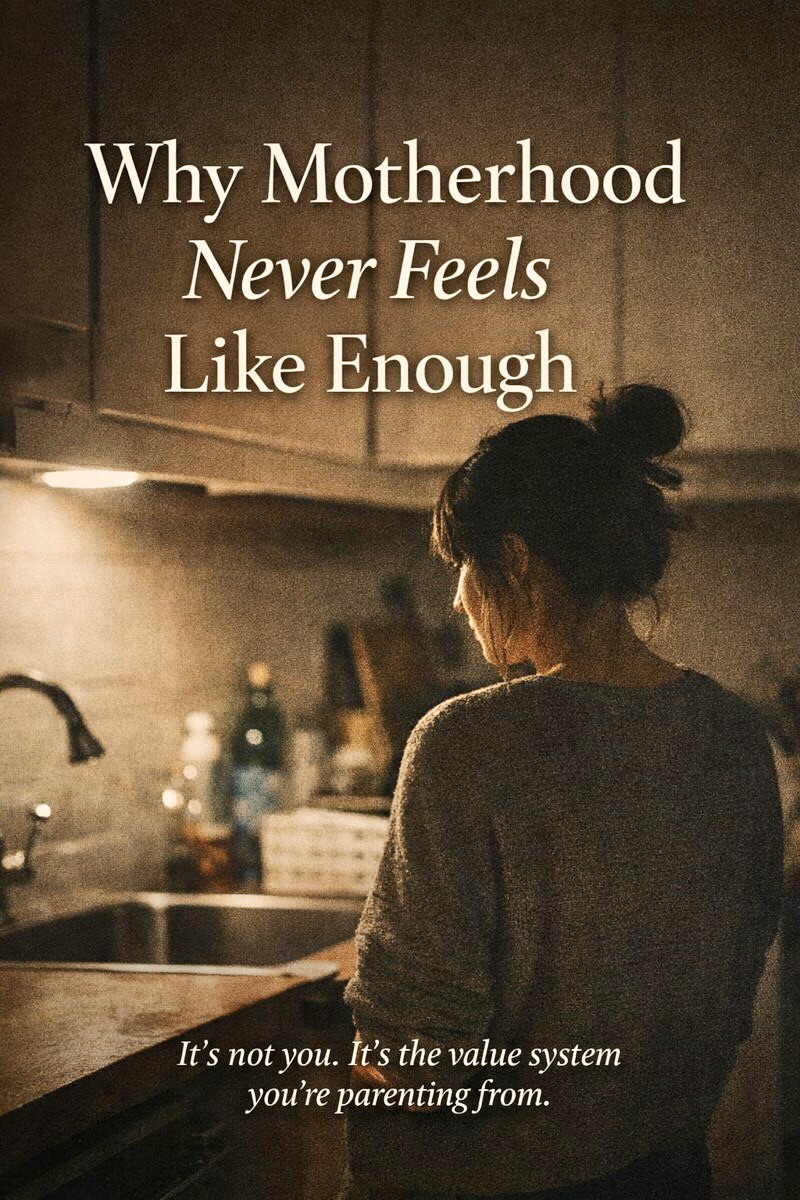
The house is finally quiet.
Not peaceful—just quiet. The kind that arrives after the last glass is in the dishwasher and the lights are dimmed, and you realise you are still standing because you forgot what you meant to do next.
Sometimes I lean against the counter and wait. I don’t know for what. Relief, maybe. Or proof that the day added up to something coherent.
Instead, what usually comes is a familiar tightening in the chest.
Was I enough today?
It doesn’t come as a question I can answer. It arrives as images and sensations: the moment I snapped. The moment I didn’t intervene. The look on my child’s face when they cried and I hesitated. The exhaustion that made everything feel louder than it should have.
In this quiet, there is no one left to reassure. No one left to perform competence for. Just the body remembering the day.
This is where motherhood is hardest for me—not in the visible moments, but here, afterward. When there is space to feel everything that was held together by momentum.
If you are here too, you’re not doing it wrong.
The Question That Won’t Stay Still
“Good enough” is a strange phrase. It sounds comforting, but it moves.
On some days, good enough means holding the boundary even when your child hates you for it.
On other days, it means staying soft when you want to shut down.
Sometimes it means planning better.
Sometimes it means giving up and ordering takeaway.
Most of us carry a version of good enough that we never consciously chose. It was shaped by our families, our cultures, our own unmet needs. By what felt dangerous once, and what felt safe.
And because so many mothers are doing this without a village, that standard doesn’t stay external. It moves inside the body. It becomes the measure of whether we can rest.
If you feel like the bar keeps shifting, it’s not because you’re failing. It’s because you are trying to meet a living system with a fixed rule.
Why It Feels So Heavy Now
We live in a time where information is everywhere and support is not.
There are books and courses and reels about every aspect of parenting. But when something breaks down at 6:30 pm—when everyone is hungry and overstimulated and you are out of words—there is often no one to hand the child to, no one to help you reset.
What used to be shared across many nervous systems now runs through one.
That’s when internal standards become relentless. What you believe about love, responsibility, and safety starts deciding whether a moment feels tolerable or catastrophic.
Some mothers feel they’ve failed if a child disobeys.
Some if the child is upset.
Some if progress stalls.
Some if the whole day collapses.
None of these responses are random. They are attempts to create safety.
And when you’re exhausted, you will reach for the one that once worked—even if it costs you now.
A Way of Making Sense (Not a Solution)
I want to offer something here—not as an answer, and not as something to do better—but as a way to feel less alone with what’s already happening.
Spiral Dynamics is a framework that describes different value logics humans move through. Not types of people. Not levels of goodness. Just different ways of organising safety, meaning, and care.
In motherhood, these logics shape what good enough feels like in the body.
You don’t choose them consciously. You slide into them when things get hard.
As you read, see if anything feels familiar. You don’t need to decide where you belong.
Blue: “Someone Has to Hold This Together”
In Blue moments, motherhood is about order and responsibility.
The rules matter because the world feels fragile. The boundary matters because without it, everything might fall apart. Love shows up as firmness, consistency, doing the hard thing even when it hurts.
A good day is one where the child behaves and the household doesn’t spiral.
The cost is often invisible: swallowed emotion, doubt that surfaces at night, the fear that softness will undo everything.
I know this logic well. I know the ache of holding a line while something in me wants to cry too.
In the supermarket:
The child drops to the floor. Blue moves quickly—voice steady, body firm. We are not doing this. Eyes are watching. Shame burns. The child slowly gets up in silence. Later, alone, the moment replays. The line held. The body didn’t rest.
If this is you sometimes, it makes sense.
Orange: “If I Just Try Harder, This Will Work”
In Orange moments, motherhood becomes a problem to solve.
There is a plan. A routine. A strategy. Love shows up as effort—researching, adjusting, optimising. If something isn’t working, the answer must be better input.
A good day is one where progress is visible.
The cost is relentless mental labour and a quiet belief that if things are hard, you must have missed something.
I see this one too. The way irritation rises not at the child, but at the inefficiency of it all.
In the supermarket:
The child screams. Orange crouches, already negotiating. We can calm down here or leave and try again. The mind races. Love looks like urgency.
If this is you, you’re not cold. You’re trying to keep things moving.
Green: “I Can’t Let Them Feel Alone”
In Green moments, motherhood is emotional presence.
The child’s inner world matters most. Feelings are named, held, mirrored. Love is attunement, and safety is emotional truth.
A good day is one where the child feels seen.
The cost is exhaustion, blurred boundaries, and the quiet sense that you are never off-duty.
I know this too—the way empathy can become a kind of self-erasure.
In the supermarket:
The child wails. Green kneels immediately. I see you. This is hard. Time stretches. The connection is real. So is the depletion.
If this is you, your care is not too much. It just hasn’t been shared.
Yellow: “This Has to Be Sustainable”
In Yellow moments, the focus widens.
The child is seen in context—body, routine, environment, history. Love shows up as containment that lasts. Boundaries are not punishments, and feelings don’t have to be fixed.
A good day is one where the system holds, even imperfectly.
The cost is often loneliness. This kind of holding is quiet. Rarely praised. Often done without backup.
In the supermarket:
The child collapses. Yellow pauses. We can calm down here and continue, or we can leave. The system stays intact. The mother carries the weight of foresight.
If this is you, it may feel like no one notices how much you’re holding.
You Are Not One Mother
Most days, we move between these logics without noticing.
We become firmer when we’re afraid.
We problem-solve when we feel responsible.
We attune when something old is touched.
We zoom out when we’re desperate for sustainability.
None of this makes you inconsistent. It makes you human.
The absence of support narrows our range. Presence—real presence—widens it again.
When the Day Is Over
Back in the kitchen, the house is quiet again.
Nothing is resolved. Some things went well. Some didn’t. You are still tired.
If the question Was I good enough? shows up, you don’t have to answer it.
You might try a different one—not to evaluate, but to accompany yourself:
What carried us today, even imperfectly?
A boundary that didn’t collapse.
A repair that happened later.
A routine that held when you couldn’t.
A moment of contact that mattered.
Motherhood is not a test you pass or fail. It is a living system, adapting in real time, often without the support it deserves.
If you are here—still trying, still caring—you are not alone in this.
And tonight, that may be enough.
Explore Further:
A Guided Path Through This Site
More Than Exhausted: The Real Story of Motherhood Burnout (+ Free Guide)
Leave a Reply